After this layoff season, the “safe” job is officially the RISKY one.
Qantas, Canva and Comcast all cut corporate roles in the same fortnight.
November 2026 is running two headlines at once. Big companies are cutting office roles, and brands are about to spend more on ads over the next 90 days than at any other time of year.
BUT : most people only read the first headline. When all your income comes from one employer, a meeting you’re not invited to decides your next year.
The good news : the research, writing and analysis you already do at work is most of a skill brands pay for directly. Cyan closed a beauty brand while hiding his phone from his boss.
Below I’ll break it down. Zero resignation letters required.

The safety net comes from 3 moves, and you keep your day job through all of them.
- Move #1 : See your job the way an analyst would. One employer is one point of failure, and this year proved it.
- Move #2 : Point the skills you already use at work at the seat brands pay for: the creative strategist, the person who decides what a brand’s ads say.
- Move #3 : Land one client while Black Friday, Christmas and the January refresh need more new ads than any other stretch of the year.
Do these and you’ll have:
- a skill more than one business pays for
- a second income that doesn’t need HR’s sign-off
- an all-staff email you can open without your stomach dropping
”I don’t necessarily believe a nine to five is any more secure than freelancing anymore.” A member who joined us in October.
First: why listen to me?
I’m Sean Ferres. I’ve spent almost 9 years in direct response marketing, and 7 of them teaching copywriters and marketers how to land clients of their own.
88 of my students have reached a six-figure income, and I want 100 by the end of 2026.
I also run my students’ ads in my own ad account, with my own money, so I see which ads work and which people brands want to keep.
(This year I brought on 30 of my own students in a single week, which tells you how many ads I need.)
So trust me when I say this.
Since the Andromeda update, the people building a second income fastest are the ones who already write, research or sell for a living, and who point that skill at a brand’s ads.
Here’s how they do it.
FIRST : See your job the way an analyst would
One employer is one point of failure
The problem:
On Tuesday the 10th of November, Qantas told staff 850 corporate roles were going, starting with finance, procurement, HR and marketing.
The week before, Canva announced job cuts affecting 1,271 roles, 22% of its global workforce, after its growth slowed for the first time in a decade.
Comcast’s layoff notices in 4 US states cover nearly 1,000 roles, and the first separations are due on New Year’s Eve.
Those calls get made in rooms most of the people affected never sit in. That’s the bit an analyst would circle in red.
Look at a typical corporate career the way you’d look at a client’s business:
- one source of income
- one person’s opinion of you deciding the next pay rise
- one meeting, scheduled by someone else, deciding your whole year
If a client showed you a business with one customer, you’d tell them to fix it before Friday.
You can’t control the next all-staff email. You can make it matter a lot less, with a second skill more than one business pays for, built while your first paycheck keeps landing.
And you’ve already done most of the training.
SECOND : Point what you already do at the seat brands pay for
You already do about 80% of this job, for one employer
Here’s the market change most people outside marketing missed.
The Andromeda update changed how ads find buyers. The ad algorithm now reads the ad itself to work out who should see it, so one ad reaches one kind of buyer.
So a brand that got by on 5 ads now wants 25 to 50 different ones per product, each aimed at a different buyer with a different reason to buy.
AI can type 50 ads before your coffee’s cool. It has no idea which 5 will make a dad in Ohio stop scrolling at 9pm.
The person who decides is called a creative strategist. They work out who’s buying, why they buy, what to say to each of them, which ads run and which get switched off.
Now look at what careful people already do at work:
- read everything before anyone else has opened the file
- turn a messy spreadsheet into a decision someone senior can act on
- write the email people actually read to the end
- get handed the important document because “you’ll catch it”
That’s most of the job. “I like a good research project,” one member told my team. She also said, “I’m not that ambitious, but I am very stubborn,” which is the best job description for this work I’ve ever heard.
The problem:
Most writers who try this go and buy a copywriting course. That same member did, for $197.
It taught her plenty about psychology and nothing about getting a client. So the coursework happens blurry-eyed after work, with no path to an actual brand.
The missing piece is the client, and that part is very learnable.
Cyan is a good example. He has a day job, and he still has it.
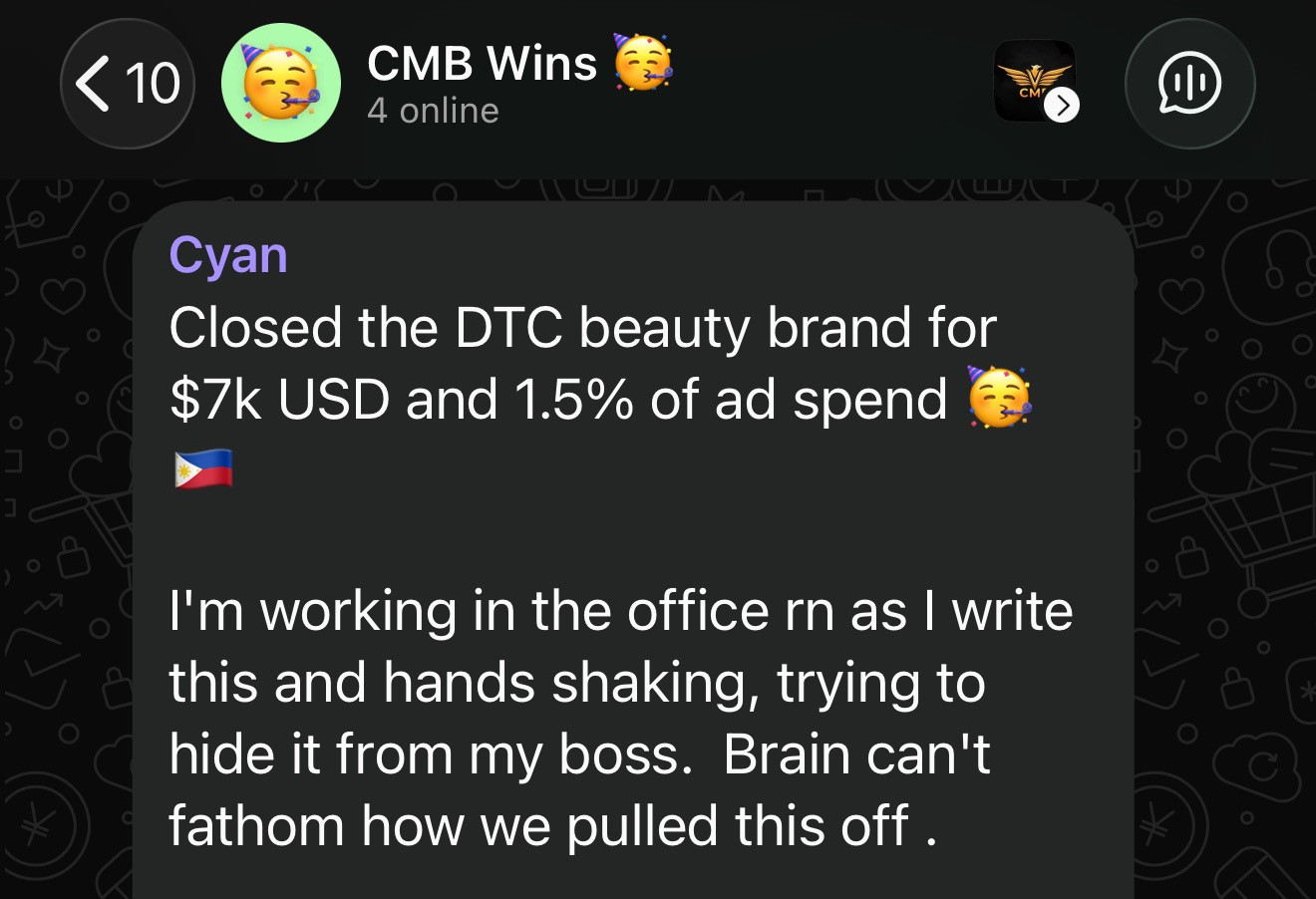
His terms with that DTC beauty brand were $7K a month plus 1.5% of ad spend. I’m not saying you’ll get that. I’m saying a brand will pay for this skill without asking you to quit anything first.
(I walk through exactly how people like Cyan go from a day job to a first client in this short video.)
THIRD : Land one client while the ads are flying
Black Friday, Christmas and January each need a fresh batch of ads
Black Friday is Friday the 27th of November. In November, the top brands go from spending around $200K a day on ads to $1M a day, and more spend burns through ads faster.
Then December hits. Shoppers stop buying for themselves and start buying for their mum and that sister who’s impossible to shop for, so every Black Friday ad goes in the bin and gets rebuilt around gifts.
Come January, the Christmas ads are worn out and brands need a fresh batch. Again.
That’s 3 rebuilds in about 90 days, with marketing teams that were already stretched. So brands do what shops do every December and bring in Christmas casuals. “5 years of experience required” goes out the window. They want to know one thing: can you help us right now?
The problem:
Most people picture 10 clients, a website and a logo before any of this counts.
You need one brand. One retainer, then a share of the ad spend once your ads work.
When my team asks new members what the money is actually for, the answers are gloriously ordinary: finish the house, finally book Japan, go on a cruise, move out of mum’s place.
Evelina’s was the last one.
She was working at Dow Jones when her marriage ended. She moved back in with her mum, and she needed an income of her own to afford the divorce and start a proper life in LA.
She learned the skill, rebuilt how she pitched herself, and closed a retainer at $4K a month plus 5% commission on ad performance.
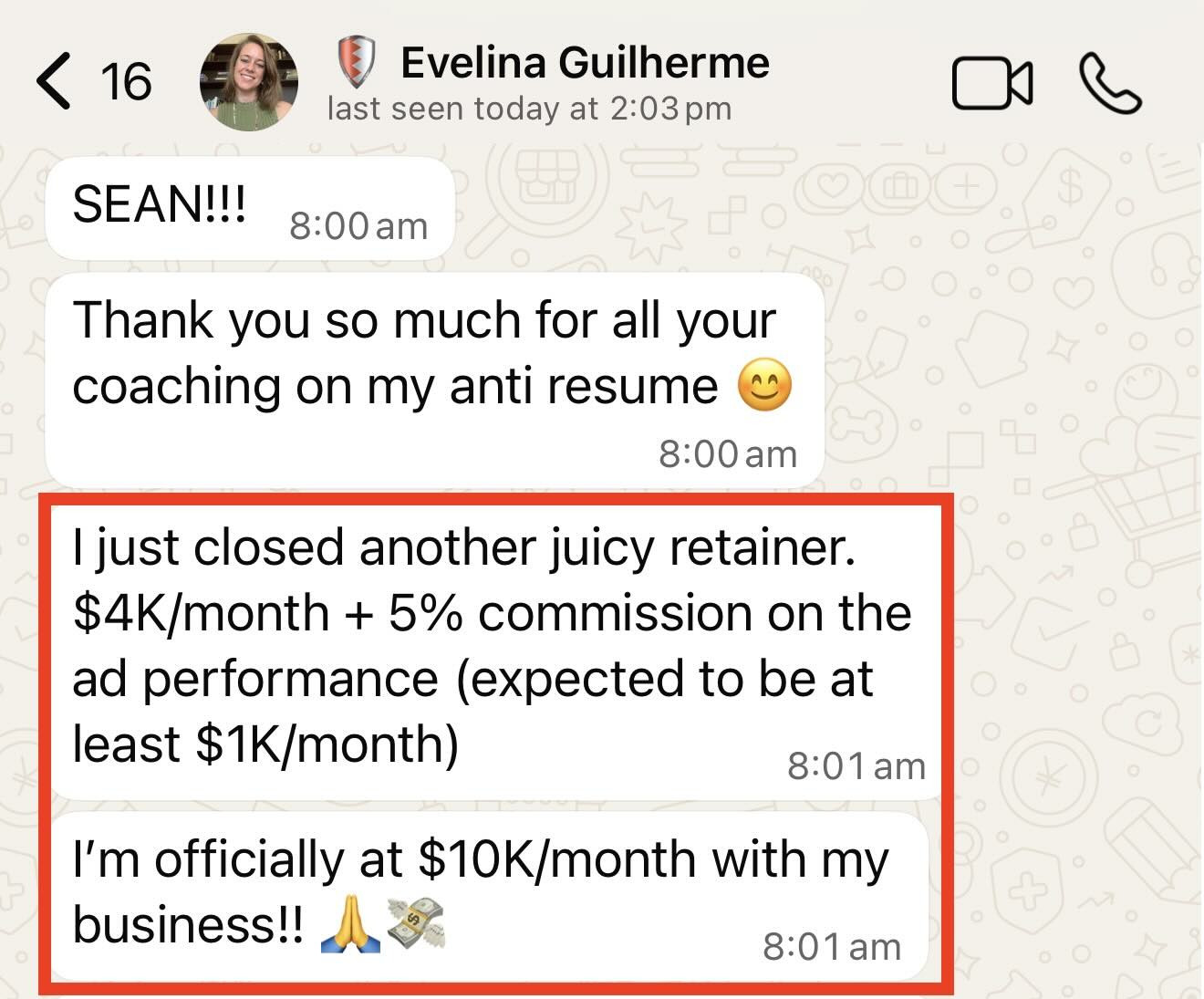
She took her business to $10K a month and went full time. These days she’s drowning in Q4 client work, training a new hire to help, and engaged to someone who’s backed her the whole way.
In her words: “CMB has allowed us to build a life that isn’t completely tied to corporate America.” (CMB is my program.)
I’m not saying you’ll get her results. She did the work every single week, and that’s the part no course can do for you.
She’s not the only one:
- Lexi got so busy she told the group she was officially out of room for new clients.
- Leilani wrote emails and had never had an ad client. Her draft application had one line in it that would have sunk her. I told her to cut it, and it turned into a trial-to-hire offer.
If you want to see the plan I’d hand you if you started this week, it’s here.
The Easy Way To Do All Of This
Look, of course I’d love you to build this with me. But make no mistake. Whether you use us or not, before January you need:
- A skill more than one business pays for, so one meeting can’t decide your year.
- Proof: ads you planned, running on real spend, in the busiest quarter of the year.
- One client, signed before the January refresh.
Do those 3 and layoff season turns into something you read about, instead of something you lie awake about.
You can piece this together yourself from YouTube, trial and error and a lot of late nights. Plenty of people do.
But if you’d like the shortcut, I’m running a 12-week Black Friday group called The Doorbusters. My team and I train you, and I run 3 of your ads in my own ad account with up to $1,000 of my own ad spend behind them, so you walk away with real proof. Then we help you turn it into retainers for 2027.
Follow the steps, and if you haven’t hit the guarantee’s target by the end of week 12, my whole team keeps working with you for up to 9 more months at no extra cost. The exact terms are on the next page.
It’s for people who already write, market or sell for a living and can find 7 to 12 focused hours a week. It’s not for anyone after passive income, or anyone who has never written, sold or marketed anything.
→ If you’d like my team and me to build your safety net with you, here’s how it works.
That’s all!
Sean
Get the next one
I write one of these when something in advertising changes and it matters for people who write, sell or market for a living. Get the next one by email.
One email when there is a new article. Unsubscribe any time. Privacy

Sean runs The Creative Strategist Breakthrough. He has spent almost 9 years in direct response and 7 of them helping copywriters land clients. 88 copywriters he has worked with have built six-figure incomes. More about Sean